Showing posts with label Paris. Show all posts

Wednesday, November 9, 2011

Paris: Random Sites

Today's post is a few random pictures from around Paris, taken on my last trip there in 2007.

First up, the Arènes de Lutèce, one of the few remains of Roman Paris (then called Lutèce in French or Lutetia in Latin). The other is the Thermes de Cluny, Roman baths which are part of the Musée du Moyen Age. I've been there as well, in 2002 with my mother, grandmother and aunt. The arena is hard to find. Even knowing where it was located and having a map, it was difficult to find, hidden away on a side street of the Latin Quarter.


A model of the arena, photo from Wikipedia.

The amphitheater could seat up to 15,000 people and was used for gladiatorial combat as well as circus shows and theatrical productions on its stage. It was built in the first century AD and is considered to be the longest Roman amphitheater of its kind.

The arena sacked during the barbaric invasions (280 AD) and stone was used to reinforce the Ile de Cite's defenses. It then became a cemetary and was completely filled in when the Wall of Phillippe August was constructed (1210 AD). It was lost until Theodore Vaquer re-discovered it during the building of the Rue Monge between 1860–1869. A preservation committee was started to save the archaeological treasure. One third of the arena was uncovered when the Couvent des Filles de Jésus-Christ was demolished in 1883. Funds were set aside by the Municipal Council to restore the arena and establish it was a public square and as such it opened in 1896. There was more excavation and restoration towards the end of World War I.


Me at the Arenas de Lutece. Photo by me.


How the arena looks today, photo from Wikipedia. As you can see, a portion of the arena was lost the buildings along rue Monge. You can still see the stage as well as the grilled cages in the wall that held wild animals. The bleachers aren't original and its believed that 41 arched openings punctuated the facade.

I also saw remnants of the Wall of Philip Augustus, mentioned above, the oldest city wall of Paris for which we know its layout. Although it was partially integrated into buildings, more traces remain than of later fortifications which were destroyed and replaced with the Grands Boulevards.
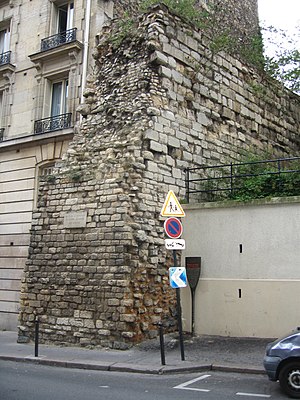

Portion along the rue Clovis. Photo from Wikipedia, but I took a very similar one when I was there.

Next up, the Eiffel Tower! Or La Tour Eiffel. Built in 1889, it is the tallest building in Paris and the most visited paid monument in the world. Architecturally speaking, it is a puddle iron lattice tower.


Photo from Wikipedia.


Up close to the Eiffel Tower. Photo by me.


Look Mom! I'm on top of the Eiffel Tower! Photo by a friend.

And now for the Arc de Triomphe. It is in the center of the Place Charles de Gaulle, originally named Place de l'Etoile for the design the streets form, at the west end of the Champs-Elysees. It was built to honor those that fought and died for France during the Revolution and during the Napoleonic Wars. Beneath its vault is the Tomb of the Unknown Soldier from the First World War. It is one of the largest triumphal arches and a biplane has been flown through its arch.


Me at the Arc de Triomphe. Photo by a friend.


Avenues radiate out from the Arc de Triomphe in a star like shape.

The Place de la Concorde is the largest square in Paris and can be found at the eastern end of the Champs-Elysees, opposite the Arc de Triomphe. The square began its life in 1755 as Place Louis XV and it showcased an equestrian statue of the king. Two identical buildings were constructed at the north end, separated by the rue Royale. One houses the French Naval Ministry while the other hosts the Hotel de Crillon, a famous luxury hotel.

During the French Revolution, the king's statue was torn down and the square was renamed Place de la Revolution. A guillotine was constructed and it was here that King Louis XVI was executed in 1793. Numerous other important and famous people were executed here as well, including the Queen. In 1795, the guillotine was removed and the square renamed Place de la Concorde.


Me at Place de la Concorde. In the background is the Obelisk of Luxor, which originally marked the entrance to the Luxor Temple. A gift from Egypt, the obelisk was placed in the center of the square in 1836, where the guillotine once stood.

And finally, a nod to my train obsession: a photo of the Cardinal Lemoine metro stop, the closest stop to my hotel. It was on line 10 of the Metro.

Monday, November 7, 2011

Paris: La Grande Mosquee de Paris and l'Institut du Monde Arabe

Even though I am Christian, I have an interest as well as a deep respect for Islam. I find the religion and the culture fascinating. So when I was in Paris, I had to go to the La Grande Mosquee.


La Grand Mosquee de Paris. June 2007.

The mosque was built in 1922 to honor the North African countries that aided France during the First World War and renovated in 1992. One hundred thousand North African tirailleurs died fighting Germany. During the Second World War, the mosque was a secret refuge for the persecuted and provided shelter, safe passage and fake Muslim birth certificates for Jewish children.

The mosque closely resembles the mosques of Marrakesh. The mosque was built following the mudejar style, based on Iberian architecture. It was constructed of reinforced concrete and decorated with Moroccan mosaics, wood carvings and wrought iron. It is still an active place of worship. Located in the Fifth Arrondissement, it is the largest mosque in France and the third largest in Europe.


The Moroccan style minaret, which is 33 meters high.


Me with the minaret in the background. I tried to be respectful of the religion and wore a scarf over my head.


Some of the elaborate mosaics and wood carvings.


In the courtyard in front of the ablutions fountain.


Outside the entrance, to the left of the minaret.

I adored the mosque and would probably visit again. Maybe next time I can take one of the guided tours.

While we're on my Islam obsession, I also visited the Institut du Monde Arabe (Museum of the Arab World). The museum exhibits calligraphy, decorative arts, architecture, and photography of the Arab world. The building was designed in 1987 by architect Jean Nouvel and includes a gift shop and Moroccan restaurant.


Tuesday, August 2, 2011

Paris: Churches

I like churches, not the modern ones, the old ones, the Gothic ones, the medieval ones. Even when I wasn't a practicing Christian, I liked churches. There's several reason for my love of churches -- the history, the architecture, the beauty, and a sense of peace that you don't get with modern versions.

While in Paris, I visited numerous churches besides the famous Notre Dame. The Pantheon. Église Saint-Germain-l'Auxerrois. Sacré-Cœur Basilica. Saint-Etienne-du-Mont. St Sulpice. I also took several pictures of random churches around town, but I don't have access to those at the moment.

First up, the Pantheon. Originally built as a church dedicated to St. Genevieve to house her remains, it is now a secular building that houses the remains of famous French citizens. The neoclassical building is breathtaking and the interior more so -- its filled with elaborate paintings and architectural elements.


The Pantheon.

Église Saint-Germain-l'Auxerrois. Located behind the Louvre, this church was the parish of the kings of France when the Louvre was still the royal residence. Originally built in the 7th century, its been rebuilt numerous times and is now a mixture of Roman, Gothic and Renaissance styles.

Interesting historical fact: The Wars of Religion took place between 1562 and 1598. During this time, there was civil as well as military fighting between the Catholics and the Huguenots who were Protestant. On the night of August 23, 1572, the bell of St Germain l'Auxerrois rang and thousands of Huguenots who were visiting for a royal wedding were killed in what would come to be known as the St Bartholomew's Day Massacre. The wedding was between Margaret, the king's sister, and the Protestant Henry II of Navarre who would become Henry IV of France.


Église Saint-Germain-l'Auxerrois. I couldn't get a good picture of the entire edifice so I settled for taking one of the doorway. My memory of the church is mainly one of peace: I'd been walking around the city, in the summer, and was quite warm. I entered the church and it was cool and dim, perfect for a tired tourist to sit down and take a break.

The Sacré-Cœur Basilica is located in Montmartre, on the butte monmartre, the highest point in the city. We chose to visit one evening in Paris because Sacre Coeur is one of the few sites open after 6 pm. When we went, the funicular wasn't working so we had to climb a lot of stairs to get to the top. Built in the late 1800s, the church combines Romano-Byzantine architecture with nationalist themes.


Sacré-Cœur Basilica. The long climb was well worth the view of the city. And the beauty of the church.

Saint-Etienne-du-Mont. This is one of my favorites from all the churches I've visited. Near the Pantheon, it contains the remains of St Genevieve, patron saint of Paris. The church has a long timeline of construction: in the 6th century, the first chapel was formed from the crypt of St Genevieve Abbey In the 13th century, a separate church built on the north side of chapel. In 1491, the bell tower was built and in 1537, the chancel. The gallery came in 1545 and the vaults of the nave and transept followed in 1580. In 1624 the bell tower was raised the the original abbey church was demolished in 1801.


Saint-Etienne-du-Mont.


St Genevieve's reliquary.


The interior of the church and the reason I think Saint-Etienne-du-Mont is one of the prettiest churches I've ever seen -- I love the double spiral staircases with the ornate stone carvings.

And finally, Eglise Saint-Sulpice. The church is the second largest in the city, behind Notre Dame. The church contains one of the world's finest and most famous organs. It also contains a gnomon. A meridian line of brass is inlaid across the floor and ascends an eleven metre high white marble obelisk that has a sphere surmounted by a cross at its peak. It was requested by the priest at the time to help him determine the equinoxes and thus when Easter fell. The obelisk is dated 1743.


The interior of St Sulpice.


My feet on the brass meridian line also known as the Rose Line. This line and the obelisk it leads to are featured in Dan Brown's work Angels and Demons, which would be one of the reasons I visited the church.

All photos are from my last trip to France, in May and June of 2007.

Monday, July 18, 2011

Paris - Cimetière du Père Lachaise

I've been to Pere Lachaise twice -- with my mother on trip number two to Paris and on my own on trip number three. My mom and I had a blast getting lost and attempting to find graves. And leaving flowers on Oscar Wilde's grave. I also have a fantastic memento of the trip -- a greyscale oil painting my mother did for me with the only color found in the flowers on Wilde's grave.

The second trip to the cemetery was also fun. On my last day in Paris, I packed up my things (I'd gone to Paris for a week with just my backpack and my purse!), and hopped on the metro to make my pilgrimage to Oscar's grave.


I took the metro right to the Pere Lachaise stop. I love the remaining Art Nouveau metro signs that you can still see around the city.

I saw several famous resting sites:


Sarah Bernhardt's grave. She was a French stage and early film actress. She was good friends with Oscar Wilde and he wrote her a play -- Salome, which was forbidden from being performed as being too scandalous. (I've read it. It's quite good.)


The grave (or at least where they are believed to be buried) of the famous French lovers Abelard and Heloise. They had a love affair and married in secret, a marriage that Heloise later denied in order to protect his career and she entered a convent at Abelard's urging. Her uncle had Abelard castrated and Heloise was forced to become a nun. Abelard became a monk, a lecturer and at one point a hermit while Heloise became an abbess. After his death, she cared for his remains until she died and was laid to rest beside him. Heloise herself was a brilliant scholar and spoke several languages.


And of course, the main reason most Americans visit Cimetière du Père Lachaise -- Jim Morrison's grave. There's a little fence in front of the grave so all admirers can do is toss flowers over.


Colette's grave. She was a novelist and performer, best known for her novel "Gigi". She was controversial throughout her career and many if not all of her books were considered scandalous. She also flaunted her lesbian affairs, and had heterosexual affairs as well. When she died in 1954, she was the first woman in France to receive a state funeral.

And finally, the reason I visited the cemetery --


Me in front of Oscar Wilde's grave, taken by a nice fellow tourist when they saw me attempting to get myself and the grave in a photo. If I'm in Paris, I have to visit his grave. I have a small, slight, little obsession with him. I mean I've just read all his plays, and his novel, and some of his poems and some of his stories and taken a class on him in college and wrote a senior research paper on him in high school and read biographies of him....Okay, maybe I'm more than a little obsessed...

Thursday, July 14, 2011

Paris: the Louvre

On my first trip to Paris, the Louvre was closed on the only free day we had. We visited Versailles instead.

On my second trip, we visited the Louvre and I explored on my own while my relatives saw the typical tourist works that I wasn't all that interested in. I went straight for the Neoclassical works.

On my third trip (where the following pictures are from), I saw some of what I wanted to see and some of what my traveling companion wanted to see. I think it worked out well.

When one enters the modern Louvre, its through a large glass pyramid.


The ceilings of the old royal palace are amazing:


We visited the 'Big Three' as I like to call them - Winged Victory, Venus de Milo and Mona Lisa:


Winged Victory which reminds me of a scene from one of my favorite movies, Funny Face with Audrey Hepburn and Fred Astaire.


Venus de Milo.

I'm a huge fan of Neoclassical sculpture, so we had to visit that gallery:


The Three Graces.


A statue of Psyche (one of my favorites from Greek mythology).


I don't remember what this was called but I'm guessing its Athena / Minerva from the helmet...

This was in the atrium sculpture area. My father is a Leo so I couldn't resist taking my picture with a lion statue.


My traveling companion was Iranian American so we had to visit the Middle Eastern areas, especially those from Persia.


Assyrian Bull.

The history of the Louvre fascinates me so we traveled down to the medieval foundations:


And visited the Ancient Egyptian section, another of my favorite time periods:


And now for my two favorite pieces of artwork in the Louvre:


Cupid and Psyche by Antonio Canova.

And


The Turkish Bath by Ingres. By the way, they have an entire room full of Ingres paintings. I was in heaven.

I love the Louvre and hope that I can return one day.

Monday, July 11, 2011

Paris: Notre Dame


Cathedrale de Notre Dame. Paris, France. June 2007.

The Story:

I've been to Paris on three separate occasions: First in 1999 with my grandmother and a church group. Second in 2002 when I was studying abroad in Luxembourg and my grandmother, mother and aunt visiting me during my vacation. And finally in 2007 when I was studying abroad for the second time and once more chose Paris for my vacation.

On the first trip, we took a tour of the cathedral. On the second, we visited and on the third, I chose to climb the towers since I'd never done it before. These photos are from that third trip.


I enjoy taking interesting shots of landmarks. Here, I was trying to capture the immense size of the cathedral's towers. Notre Dame, Paris, June 2007.

As mentioned above, I decided to climb the towers - a task that involved standing in line (I grabbed a sandwich before I got in line, I believe it was ham, cheese and butter on a baguette from a street vendor. And it was delicious!), lots of small steep winding stairs and fantastic views of the cathedral and the city:


The square in front of Notre Dame from one of the towers. Originally, only that center defined area was open and a road, the rest was buildings. If you look closely, you can see steps at the back of the square. Those lead down to the Archaeological Crypt, a museum that explores the history of the city, from the original tribes onward. Notre Dame, Paris, June 2007.


This is a shot looking down from the towers at he flying buttresses supporting the massive walls of the cathedral. Notre Dame, Paris, June 2007.


My feet on Point Zero. It is considered the official center of the city. Distances between Paris and other French cities are measured from this point. However, I visited it because of its Dan Brown fame. Paris June 2007.

I also took a walk around the city at night with a couple of classmates. Here's a shot of the cathedral all lit up for the night:


Paris, June 2007